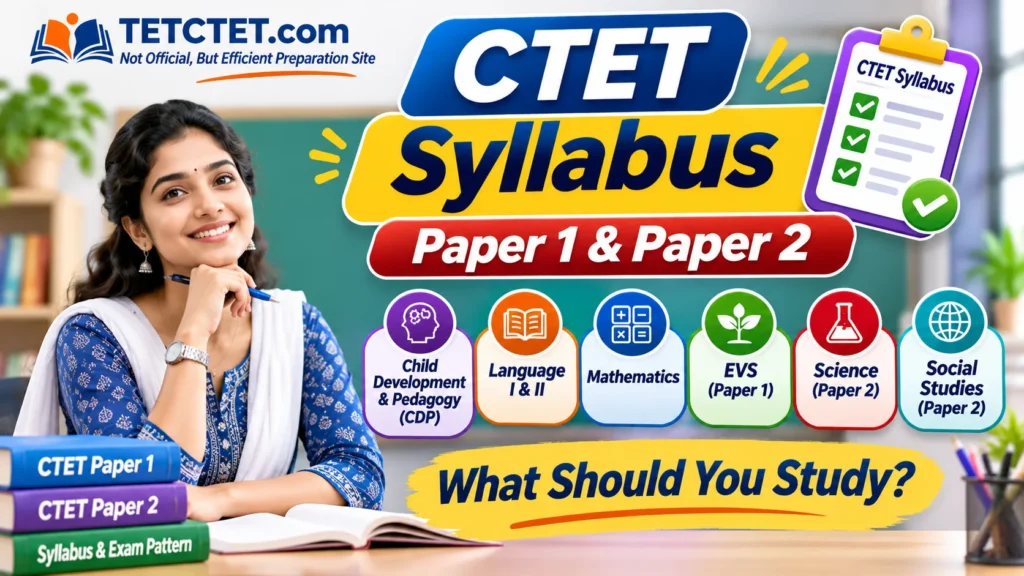
Preparing for the Central Teacher Eligibility Test (CTET) becomes much easier when you know exactly what to study.
But if you have recently started preparing, the syllabus may seem confusing.
Should you study Mathematics for both papers? Is Environmental Studies included in Paper 2? How important is Child Development and Pedagogy? And are NCERT textbooks enough for CTET preparation?
These are common questions among teaching aspirants.
The good news is that the CTET syllabus is clearly divided into subjects and teaching levels. Once you understand the structure, you can plan your preparation without spending time on unnecessary topics.
CTET is conducted by the Central Board of Secondary Education (CBSE). It assesses candidates’ subject knowledge, understanding of child development, and ability to apply appropriate teaching methods.
The examination has two papers:
- CTET Paper 1: For candidates intending to teach Classes 1 to 5.
- CTET Paper 2: For candidates intending to teach Classes 6 to 8.
Both papers contain 150 multiple-choice questions, but their subject requirements are different.
In this guide, we explain the complete CTET syllabus for Paper 1 and Paper 2, including important topics, marks distribution, pedagogy sections, the difference between the two papers, and practical preparation strategies.
The syllabus details are based on the official CBSE CTET Information Bulletin.
CTET Syllabus Overview
Before studying individual subjects, it helps to understand the overall examination structure.
CTET focuses on two major areas.
The first is subject knowledge, which includes Mathematics, Environmental Studies, Science, Social Studies, languages, and other relevant concepts.
The second is pedagogy, which means understanding how to teach those subjects effectively.
For example, knowing how to solve a Mathematics problem is subject knowledge.
Understanding why a child makes a particular mistake, and choosing an effective way to explain the concept, is pedagogy.
Both are important in CTET.
CTET Paper 1 and Paper 2: Key Differences
| Feature | Paper 1 | Paper 2 |
|---|---|---|
| Teaching classes | Classes 1–5 | Classes 6–8 |
| Teaching stage | Primary | Upper Primary |
| Total questions | 150 | 150 |
| Total marks | 150 | 150 |
| Examination duration | 2 hours 30 minutes | 2 hours 30 minutes |
| Child Development and Pedagogy | 30 marks | 30 marks |
| Language I | 30 marks | 30 marks |
| Language II | 30 marks | 30 marks |
| Subject-specific section | Mathematics and EVS | Mathematics and Science OR Social Studies |
| Negative marking | No | No |
Candidates who want to qualify for teaching both levels must appear in both papers, subject to the applicable eligibility requirements.
CTET Paper 1 Syllabus for Classes 1 to 5
CTET Paper 1 is intended for candidates who want to teach at the primary school level.
At this stage, children develop foundational knowledge in reading, writing, Mathematics, communication, and understanding their surroundings.
The syllabus therefore includes both primary-level subject concepts and methods of teaching young children.
CTET Paper 1 Exam Pattern
| Subject | Questions | Marks |
|---|---|---|
| Child Development and Pedagogy | 30 | 30 |
| Language I | 30 | 30 |
| Language II | 30 | 30 |
| Mathematics | 30 | 30 |
| Environmental Studies | 30 | 30 |
| Total | 150 | 150 |
All five subjects are compulsory.
The examination duration is 150 minutes, and there is no negative marking.
1. Child Development and Pedagogy Syllabus – Paper 1
Total: 30 Questions | 30 Marks
Child Development and Pedagogy, commonly called CDP, is one of the most important subjects in CTET.
It examines how children grow, learn, think, interact, and develop knowledge.
For Paper 1, the focus is mainly on children aged approximately 6 to 11 years.
The official syllabus divides the subject into three parts.
| Section | Questions |
|---|---|
| Child Development | 15 |
| Inclusive Education and Children with Special Needs | 5 |
| Learning and Pedagogy | 10 |
| Total | 30 |
A. Child Development – 15 Questions
Important topics include:
- Meaning of child development and its relationship with learning.
- Major principles and patterns of development.
- Influence of heredity and environment.
- Socialisation through family, teachers, and peers.
- Jean Piaget’s theory of cognitive development.
- Lawrence Kohlberg’s theory of moral development.
- Lev Vygotsky’s sociocultural theory.
- Child-centred and progressive education.
- Intelligence and different perspectives on intelligence.
- Language development and its relationship with thinking.
- Gender roles, stereotypes, and classroom practices.
- Individual differences among learners.
- Assessment for learning and assessment of learning.
- School-based assessment and Continuous and Comprehensive Evaluation (CCE).
- Questions that encourage understanding and critical thinking.
How to prepare: Understand each theory instead of memorising only the psychologist’s name.
For example, Piaget’s theory helps explain how children’s thinking develops. Vygotsky’s ideas highlight the role of interaction and support in learning.
CTET may ask you to apply such ideas to a classroom situation.
B. Inclusive Education – 5 Questions
This section focuses on making learning accessible to all children.
Important topics include children from different social and cultural backgrounds, learners experiencing educational disadvantages, learning difficulties, disabilities, gifted learners, and creative learners.
You should also understand why a teacher may need to adapt classroom activities for different learning needs.
Practical example: Imagine a classroom where one student learns quickly through pictures while another needs additional explanation and practice.
An inclusive teacher plans learning activities that support both students instead of expecting everyone to learn in exactly the same way.
C. Learning and Pedagogy – 10 Questions
This section examines the teaching-learning process.
Important topics include:
- How children think and learn.
- Learning as a social activity.
- Reasons children experience learning difficulties.
- Problem-solving and inquiry-based learning.
- Children’s errors and misconceptions.
- Motivation and learning.
- The relationship between cognition and emotions.
- Personal and environmental factors affecting learning.
- Learning through interaction, discussion, and experience.
A strong understanding of these topics is useful beyond the CDP section because pedagogy questions also appear in other CTET subjects.
2. CTET Mathematics Syllabus – Paper 1
Total: 30 Questions | 30 Marks
Mathematics in Paper 1 focuses on primary-level concepts and the methods used to teach them.
The official distribution is:
| Section | Questions |
|---|---|
| Mathematics Content | 15 |
| Mathematics Pedagogy | 15 |
| Total | 30 |
This means half of the Mathematics questions are related to teaching methods.
A. Mathematics Content – 15 Questions
Important topics include:
Numbers and Arithmetic
- Number concepts and place value.
- Addition and subtraction.
- Multiplication and division.
- Number relationships and basic calculations.
Geometry and Shapes
- Basic geometry.
- Two-dimensional shapes.
- Three-dimensional solids.
- Spatial understanding.
- Recognising and comparing shapes.
Measurement
- Length and measurement concepts.
- Weight.
- Time.
- Volume.
- Money and everyday calculations.
Patterns and Data Handling
- Recognising number and shape patterns.
- Understanding and organising information.
- Interpreting simple data.
B. Mathematics Pedagogy – 15 Questions
Important topics include:
- Nature of Mathematics and logical thinking.
- Importance of Mathematics in the curriculum.
- Language used in Mathematics.
- Mathematics in everyday life.
- Understanding children’s mathematical reasoning.
- Formal and informal assessment methods.
- Common teaching difficulties.
- Error analysis.
- Diagnostic and remedial teaching.
Example of a Mathematics Pedagogy Question
A Class 3 student believes that 1/4 is greater than 1/3 because 4 is greater than 3.
What should the teacher do?
Simply telling the student that the answer is wrong may not address the misunderstanding.
A more useful approach is to show equal-sized paper strips or diagrams divided into thirds and fourths.
This helps the student see how fractions represent parts of a whole.
Such classroom-based reasoning is important for CTET Mathematics pedagogy.
Preparation tip: Practise both numerical MCQs and questions about the most suitable teaching method.
3. CTET Environmental Studies Syllabus – Paper 1
Total: 30 Questions | 30 Marks
Environmental Studies, commonly called EVS, helps primary students understand their surroundings, relationships, and everyday experiences.
It brings together ideas from Science, Social Science, and environmental education.
The official distribution is:
| Section | Questions |
|---|---|
| EVS Content | 15 |
| EVS Pedagogy | 15 |
| Total | 30 |
A. Environmental Studies Content – 15 Questions
The official syllabus covers six broad areas.
1. Family and Friends
This includes relationships, work and play, animals, and plants.
Candidates should understand family and community life, different occupations, the natural world, and how children learn from their surroundings.
2. Food
This includes food habits, sources of food, and related everyday experiences.
3. Shelter
This area deals with homes, shelters, and the relationship between living conditions and the environment.
4. Water
Important concepts include the uses of water, water sources, and the importance of water in daily life.
5. Travel
This includes transport, journeys, and related experiences.
6. Things We Make and Do
This covers objects, materials, activities, and the ways people interact with their surroundings.
B. Environmental Studies Pedagogy – 15 Questions
Important topics include:
- Meaning, nature, and scope of EVS.
- Importance of integrated EVS.
- Relationship between EVS, Science, and Social Science.
- Principles of teaching and learning EVS.
- Activity-based learning.
- Observation and practical activities.
- Experimentation and discussion.
- Teaching aids and learning materials.
- Assessment and CCE.
- Common problems in teaching EVS.
Example of an EVS Pedagogy Question
Suppose a teacher wants Class 4 students to understand different types of plants.
Which teaching method would be most useful?
Students could observe plants in the school garden, compare their leaves, and discuss what they notice.
This provides direct learning experiences rather than relying only on textbook definitions.
Preparation tip: Connect EVS concepts with real-life situations, classroom activities, observation, and discussion.
4. CTET Language I Syllabus – Paper 1
Total: 30 Questions | 30 Marks
Language I focuses on language proficiency related to the medium of instruction.
Candidates must choose a language from the options officially offered by CTET.
The syllabus has two sections.
| Section | Questions |
|---|---|
| Language Comprehension | 15 |
| Pedagogy of Language Development | 15 |
| Total | 30 |
A. Language Comprehension – 15 Questions
The official syllabus includes two unseen passages:
- One prose or drama passage.
- One poem.
Questions may assess comprehension, inference, grammar, vocabulary, and verbal ability.
The prose passage may be literary, narrative, scientific, or discursive.
B. Language Pedagogy – 15 Questions
Important topics include:
- Language learning and acquisition.
- Principles of language teaching.
- Listening and speaking skills.
- Reading and writing development.
- Role of grammar in communication.
- Teaching in multilingual classrooms.
- Language learning difficulties.
- Assessment of language skills.
- Teaching-learning materials.
- Remedial teaching.
Preparation tip: Do not prepare Language I as a grammar-only subject. Reading comprehension and language teaching methods are equally important.
5. CTET Language II Syllabus – Paper 1
Total: 30 Questions | 30 Marks
Language II must be different from Language I.
For example, a candidate may choose Telugu as Language I and English as Language II, if these choices suit the candidate’s proficiency and the applicable rules.
The official Language II syllabus includes:
| Section | Questions |
|---|---|
| Comprehension | 15 |
| Pedagogy of Language Development | 15 |
| Total | 30 |
A. Comprehension – 15 Questions
The syllabus includes two unseen prose passages.
These may be literary, narrative, scientific, or discursive.
Questions assess comprehension, grammar, and verbal ability.
B. Language Pedagogy – 15 Questions
Topics include language acquisition, communication, language skills, classroom learning methods, multilingual classrooms, assessment, teaching resources, and remedial teaching.
Difference Between Language I and Language II
Language I emphasises proficiency related to the medium of instruction.
Language II emphasises language elements, communication, and comprehension.
The comprehension passage patterns also differ.
Language I includes a prose or drama passage and a poem, while Language II includes two prose passages.
Important: The main CTET question paper is bilingual in Hindi and English. Selecting Telugu or another offered language as Language I or Language II does not mean every subject section will be printed in that regional language.
CTET Paper 2 Syllabus for Classes 6 to 8
CTET Paper 2 is intended for candidates who want to teach at the upper-primary level.
The syllabus covers Child Development and Pedagogy, two languages, and a subject-specific section.
Candidates choose either Mathematics and Science or Social Studies/Social Science according to their intended teaching subject and the applicable requirements.
CTET Paper 2 Exam Pattern
| Subject | Questions | Marks |
|---|---|---|
| Child Development and Pedagogy | 30 | 30 |
| Language I | 30 | 30 |
| Language II | 30 | 30 |
| Mathematics and Science OR Social Studies/Social Science | 60 | 60 |
| Total | 150 | 150 |
The examination duration is 2 hours and 30 minutes, with no negative marking.
1. Child Development and Pedagogy Syllabus – Paper 2
Total: 30 Questions | 30 Marks
The broad syllabus is similar to Paper 1, but the focus changes to the educational psychology of children aged approximately 11 to 14 years.
| Section | Questions |
|---|---|
| Child Development | 15 |
| Inclusive Education | 5 |
| Learning and Pedagogy | 10 |
| Total | 30 |
A. Child Development – 15 Questions
Important topics include child development and learning, heredity and environment, socialisation, Piaget’s cognitive development theory, Kohlberg’s moral development theory, and Vygotsky’s sociocultural theory.
Candidates should also prepare intelligence, language and thought, individual differences, gender and education, child-centred learning, and assessment methods.
B. Inclusive Education – 5 Questions
This includes understanding learner diversity, supporting children experiencing educational disadvantages, addressing learning difficulties, and planning suitable learning experiences for children with different abilities.
C. Learning and Pedagogy – 10 Questions
This section includes learning processes, motivation, problem-solving, classroom interaction, learning difficulties, cognition, emotions, and the role of personal and environmental factors.
How Is Paper 2 CDP Different from Paper 1?
Consider the same topic: classroom participation.
For younger primary students, a question might focus on learning through play and simple group activities.
For upper-primary students, a question may focus on discussion, reasoning, peer interaction, and opportunities to develop independent thinking.
The underlying educational principles overlap, but their application is different.
2. CTET Paper 2 Mathematics Syllabus
Mathematics: 30 Questions | 30 Marks
This section applies to candidates choosing the Mathematics and Science option.
The official distribution is:
| Section | Questions |
|---|---|
| Mathematics Content | 20 |
| Mathematics Pedagogy | 10 |
| Total | 30 |
A. Mathematics Content – 20 Questions
The official syllabus includes the following major areas.
Number System
- Understanding numbers.
- Whole numbers.
- Negative numbers and integers.
- Fractions.
- Properties and relationships of numbers.
Algebra
- Introduction to algebraic concepts.
- Variables and simple expressions.
- Ratio and proportion.
Geometry
- Basic geometrical ideas.
- Two-dimensional and three-dimensional shapes.
- Symmetry and reflection.
- Geometrical constructions using rulers, protractors, and compasses.
Mensuration
- Measurement of geometrical figures.
- Related calculations and concepts.
Data Handling
- Organising data.
- Representing information.
- Interpreting data.
B. Mathematics Pedagogy – 10 Questions
Important topics include:
- Nature of Mathematics and logical reasoning.
- Role of Mathematics in the curriculum.
- Mathematical language and communication.
- Everyday applications of Mathematics.
- Evaluation of mathematical learning.
- Common difficulties in teaching Mathematics.
- Diagnostic and remedial teaching.
Preparation tip: Study upper-primary NCERT Mathematics concepts while practising questions that test how students understand or misunderstand them.
For example, a student who incorrectly expands 2(x + 3) as 2x + 3 needs help understanding the distributive property, not merely an answer to copy.
3. CTET Paper 2 Science Syllabus
Science: 30 Questions | 30 Marks
Science is the second part of the Mathematics and Science option.
| Section | Questions |
|---|---|
| Science Content | 20 |
| Science Pedagogy | 10 |
| Total | 30 |
A. Science Content – 20 Questions
The syllabus includes six major themes.
1. Food
Sources of food, components of food, and food-related processes.
2. Materials
Different materials used in daily life and their properties.
3. The World of the Living
Living organisms, plants, animals, and related biological concepts.
4. Moving Things, People and Ideas
Basic concepts associated with movement and related phenomena.
5. How Things Work
Important topics include electric current, circuits, and magnets.
6. Natural Phenomena and Natural Resources
Concepts related to natural processes, resources, and the environment.
These broad themes connect to Physics, Chemistry, Biology, and Environmental Science at the upper-primary level.
B. Science Pedagogy – 10 Questions
Important topics include:
- Nature and structure of Science.
- Aims and objectives of Science teaching.
- Scientific understanding and inquiry.
- Observation, experimentation, and discovery.
- Integrated approaches to Science teaching.
- Teaching-learning materials.
- Assessment of scientific understanding and skills.
- Teaching difficulties and remedial approaches.
Example of a Science Pedagogy Question
A teacher wants students to understand which materials allow electricity to pass through them.
Instead of asking students to memorise a list of conductors and insulators, the teacher can organise a safe, supervised activity using a low-voltage circuit and suitable materials.
Students can observe results, compare findings, and draw conclusions.
This encourages scientific inquiry and conceptual understanding.
Preparation tip: For each Science topic, practise factual questions and questions involving experiments, observations, misconceptions, and teaching methods.
4. CTET Paper 2 Social Studies/Social Science Syllabus
Total: 60 Questions | 60 Marks
Candidates selecting the Social Studies/Social Science option answer questions from History, Geography, Social and Political Life, and Social Science pedagogy.
The official distribution is:
| Section | Questions |
|---|---|
| Social Studies Content | 40 |
| Social Studies Pedagogy | 20 |
| Total | 60 |
The official bulletin does not prescribe a fixed question count separately for History, Geography, and Social and Political Life within those 40 content questions.
A. History Syllabus
Important areas include:
Early Indian History
- Sources and methods of studying the past.
- Earliest human societies.
- Early farming and pastoral communities.
- First cities.
- Early states and empires.
- Religious and philosophical ideas.
- Cultural and scientific developments.
Medieval Indian History
- Kingdoms and political changes.
- Delhi Sultanate.
- Development of architecture.
- Formation and expansion of empires.
- Regional cultures.
- Social and cultural change.
Modern Indian History
- Growth of British East India Company rule.
- Colonialism and its effects.
- Rural communities and tribal societies.
- Revolt of 1857.
- Social and religious reform.
- Challenges to caste-based inequality.
- Indian national movement.
- India after Independence.
Candidates should understand chronology, historical developments, causes and consequences, and the use of historical evidence.
B. Geography Syllabus
Important topics include:
- Nature and scope of Geography.
- Earth and the solar system.
- Globe and geographical representation.
- Natural and human environments.
- Air and water.
- Human settlements.
- Transport and communication.
- Natural and human resources.
- Agriculture.
Focus on understanding geographical relationships rather than only memorising place names.
For example, understanding why a particular crop grows well in certain climatic conditions is more useful than memorising isolated facts.
C. Social and Political Life Syllabus
Important topics include:
- Diversity in society.
- Government and its functions.
- Local government.
- Livelihoods and occupations.
- Democracy.
- State governments.
- Media and society.
- Gender and social equality.
- Indian Constitution.
- Parliamentary government.
- Judiciary.
- Social justice and marginalised communities.
These topics help students understand society, democratic institutions, rights, responsibilities, and public life.
D. Social Studies Pedagogy – 20 Questions
Important topics include:
- Nature and purpose of Social Studies.
- Classroom activities and discussion.
- Developing critical thinking.
- Inquiry-based learning.
- Using empirical evidence.
- Primary and secondary sources.
- Project-based learning.
- Common difficulties in teaching Social Studies.
- Evaluation and assessment.
Example of a Social Studies Pedagogy Question
Suppose students are learning about historical events.
A teacher could provide photographs, maps, written records, and other suitable sources.
Students can compare the information and discuss what the evidence suggests.
This helps them understand that History involves examining evidence, not simply memorising dates.
Preparation tip: Practise content MCQs alongside source-based, classroom-based, and teaching-method questions.
5. CTET Paper 2 Language I Syllabus
Total: 30 Questions | 30 Marks
The official distribution is:
| Section | Questions |
|---|---|
| Language Comprehension | 15 |
| Language Pedagogy | 15 |
| Total | 30 |
Language comprehension includes an unseen prose or drama passage and a poem.
Questions may test comprehension, inference, grammar, and verbal ability.
Language pedagogy includes learning and acquisition, language teaching principles, listening and speaking, reading and writing, multilingual classrooms, assessment, teaching resources, and remedial teaching.
For Paper 2, candidates should practise understanding longer ideas and selecting appropriate language teaching strategies for upper-primary learners.
6. CTET Paper 2 Language II Syllabus
Total: 30 Questions | 30 Marks
The syllabus includes:
| Section | Questions |
|---|---|
| Comprehension | 15 |
| Pedagogy of Language Development | 15 |
| Total | 30 |
The comprehension section includes two unseen prose passages.
The pedagogy section covers language acquisition, communication, language skills, classroom teaching, assessment, and support for learners experiencing difficulties.
Language II must be different from Language I.
Candidates should choose their languages based on the officially available options and their ability to understand and answer questions accurately.
CTET Paper 1 vs Paper 2: Syllabus Comparison
The two papers share some subjects, but their subject-specific sections differ.
| Subject | Paper 1 | Paper 2 |
|---|---|---|
| Child Development and Pedagogy | Compulsory | Compulsory |
| Language I | Compulsory | Compulsory |
| Language II | Compulsory | Compulsory |
| Mathematics | 30 marks | 30 marks within Mathematics and Science option |
| Environmental Studies | 30 marks | No separate EVS section |
| Science | No separate section | 30 marks within Mathematics and Science option |
| Social Studies/Social Science | No separate section | 60-mark alternative subject option |
| Subject pedagogy | Included | Included |
Can You Prepare for Both CTET Papers Together?
Yes, if you meet the relevant eligibility requirements.
A combined preparation plan can be useful because Child Development and Pedagogy, Language I, and Language II are compulsory in both papers.
However, subject-specific preparation must be separate.
For example, preparing primary-level Mathematics alone is not enough for the upper-primary Mathematics section.
Similarly, Paper 1 EVS preparation does not replace Paper 2 Science or Social Studies.
Which NCERT Books Should You Study for CTET?
NCERT textbooks are important preparation resources because the CTET syllabus is based on the relevant NCERT curriculum.
For CTET Paper 1
Start with NCERT materials covering Classes 1–5, particularly Mathematics and Environmental Studies, along with suitable language resources.
For CTET Paper 2
Study the relevant NCERT subjects for Classes 6–8.
For Mathematics and Science candidates, focus on both subjects and their teaching methods.
For Social Studies candidates, cover History, Geography, and Social and Political Life.
Are NCERT Books Alone Enough?
NCERT textbooks provide a strong foundation for subject concepts, but CTET also tests pedagogy.
You should therefore prepare child development, learning theories, inclusive education, language teaching, and subject-specific pedagogy separately.
Also, do not assume that questions can only be as difficult as the corresponding school textbook exercises.
The CTET bulletin explains that Paper 1 questions are based on the Classes 1–5 curriculum but their difficulty and connections may extend to the secondary stage.
For Paper 2, the difficulty and conceptual connections may extend to the senior secondary stage.
This does not mean every higher-class topic automatically becomes part of the syllabus. It means candidates need a sound understanding of the prescribed concepts.
Important: As NCERT textbooks and curricula are revised, match your study resources with the syllabus and guidance in the applicable official CTET bulletin.
How to Prepare for CTET Syllabus Effectively
Completing the CTET syllabus requires more than reading textbooks from beginning to end.
A useful preparation strategy has four parts.
1. Understand the Official Syllabus
Begin by reviewing the subjects in your chosen paper.
Separate topics into those you already understand, those needing revision, and those you have not yet studied.
This prevents you from spending too much time on familiar topics while ignoring weaker areas.
2. Give Pedagogy Proper Attention
Pedagogy is not a small extra section.
In Paper 1, Mathematics and EVS each contain 15 pedagogy questions.
In Paper 2, Mathematics and Science each contain 10 pedagogy questions, while Social Studies contains 20.
Child Development and Pedagogy is also a compulsory 30-mark section in both papers.
This makes teaching and learning concepts an important part of the examination.
3. Practise Topic-Wise MCQs
After studying a topic, solve a set of questions related to it.
For example, after studying Vygotsky, practise questions about social interaction, guided learning, and classroom support.
After studying Mathematics fractions, practise both numerical problems and questions about teaching fractions.
This helps you check whether you can apply what you have learned.
4. Attempt Full-Length Tests and Review Mistakes
Once you have covered several subjects, begin full-length mock tests.
Review every incorrect answer.
Try to identify whether the mistake came from weak subject knowledge, misunderstanding the question, or difficulty applying a teaching principle.
Do not judge your preparation only by the number of tests completed.
The improvement you make after each test matters more.
A Practical Six-Week CTET Study Plan
The following is a suggested revision framework for candidates who already have some subject knowledge. It is not an official CBSE timetable.
| Week | Preparation Focus |
|---|---|
| Week 1 | Child Development, learning theories, and inclusive education |
| Week 2 | Language I and Language II comprehension and pedagogy |
| Week 3 | Paper-specific subject content, first half |
| Week 4 | Remaining subject content and subject pedagogy |
| Week 5 | Previous-year questions, topic tests, and revision |
| Week 6 | Full-length mock tests, error review, and final revision |
Candidates starting from the beginning may need more preparation time.
How Much Time Should You Spend on Each Subject?
There is no single study timetable that works for everyone.
However, a balanced routine should include concept study, question practice, pedagogy, and revision.
For example, a candidate preparing for Paper 1 might study CDP, Language I or II, and Mathematics or EVS on a particular day.
The next day, the candidate can rotate the subject while revising concepts studied earlier.
The aim is to build continuity without ignoring any compulsory section.
Common Mistakes to Avoid While Preparing the CTET Syllabus
Mistake 1: Ignoring Pedagogy
Some candidates focus only on definitions, formulas, and subject facts.
CTET also tests teaching methods and classroom understanding.
Mistake 2: Using the Paper 1 Syllabus for Paper 2
Although both papers share common subjects, they cover different teaching levels and subject-specific topics.
Mistake 3: Treating Language Preparation as Grammar Only
Both language sections include substantial comprehension and pedagogy components.
Mistake 4: Memorising Learning Theories Without Understanding Them
Questions about Piaget, Vygotsky, and Kohlberg may require applying theories to situations involving children.
Mistake 5: Ignoring Previous-Year Question Papers
Previous-year questions help you understand how syllabus concepts are tested.
However, they should supplement complete preparation, not replace it.
Mistake 6: Trusting Unofficial Topic Weightages
The official bulletin specifies question counts for major sections and subdivisions.
It does not prescribe an exact number of questions for every individual chapter or named topic.
Avoid treating coaching predictions as guaranteed weightages.
Prepare for CTET with TETCTET.com
Understanding the syllabus is the first step. Regular practice helps you check whether you can answer questions based on it.
At TETCTET.com, we aim to support CTET and State TET aspirants with accessible preparation resources.
Our resources include:
- Free practice tests.
- Paid practice test series.
- Previous-year question papers (PYQs).
- Topic-wise and subject-wise practice resources.
- Study materials and additional learning resources as available.
Whether you are preparing for CTET Paper 1 or Paper 2, practise regularly and revise the subjects where you need improvement.
Explore the available CTET preparation resources at TETCTET.com.
Not Official, But Efficient Preparation Site.
Frequently Asked Questions About the CTET Syllabus
1. What is the CTET syllabus for Paper 1?
CTET Paper 1 includes Child Development and Pedagogy, Language I, Language II, Mathematics, and Environmental Studies. Each subject carries 30 marks.
2. What is the CTET syllabus for Paper 2?
CTET Paper 2 includes Child Development and Pedagogy, Language I, Language II, and either Mathematics and Science or Social Studies/Social Science.
3. How many questions are there in CTET Paper 1?
Paper 1 contains 150 multiple-choice questions carrying 150 marks.
4. How many questions are there in CTET Paper 2?
Paper 2 also contains 150 multiple-choice questions carrying 150 marks.
5. Is the CTET Paper 1 syllabus different from Paper 2?
Yes. The papers have common subjects but different subject-specific sections and teaching-level requirements.
6. Is Child Development and Pedagogy compulsory in both papers?
Yes. It is compulsory in both Paper 1 and Paper 2 and carries 30 marks in each paper.
7. How many pedagogy questions are there in Paper 1 Mathematics?
Paper 1 Mathematics includes 15 content questions and 15 pedagogy questions.
8. How many pedagogy questions are there in Paper 1 EVS?
Paper 1 EVS includes 15 content questions and 15 pedagogy questions.
9. Is Environmental Studies included in CTET Paper 2?
No. Paper 2 does not have a separate EVS section. Candidates choose Mathematics and Science or Social Studies/Social Science.
10. Is Mathematics compulsory for every CTET Paper 2 candidate?
No. Mathematics is part of the Mathematics and Science option. Candidates selecting Social Studies/Social Science answer that section instead.
11. How many questions are asked from Science in Paper 2?
The Science portion contains 30 questions: 20 content questions and 10 Science pedagogy questions.
12. How many questions are asked from Social Studies in Paper 2?
Social Studies/Social Science contains 60 questions, including 40 content questions and 20 pedagogy questions.
13. Is the CTET syllabus based on NCERT?
Yes. The official syllabus draws on NCERT curriculum topics for the relevant teaching levels. Candidates should also study pedagogy and follow the official bulletin.
14. Can I prepare for CTET using only NCERT textbooks?
NCERT textbooks are useful for subject knowledge, but separate preparation for child development and pedagogy is also important.
15. Are Language I and Language II the same?
No. Language I focuses on proficiency related to the medium of instruction, while Language II focuses on language elements, communication, and comprehension. Candidates must choose different languages.
16. Can I choose Telugu and English for CTET?
Both Telugu and English are among the official CTET language options. Candidates can choose them as two different language papers according to the applicable rules.
17. Does the CTET syllabus include teaching methods?
Yes. Child Development and Pedagogy and the pedagogy sections of other subjects assess understanding of teaching methods and classroom learning.
18. Is there negative marking in CTET?
No. Under the current CTET pattern, there is no negative marking.
19. How long is the CTET examination?
Each paper has a duration of 2 hours and 30 minutes.
20. What are the general qualifying marks for CTET?
The general qualifying benchmark is 60%, equivalent to 90 marks out of 150. Applicable concessions depend on relevant policies.
21. Can I prepare for both CTET papers together?
Yes. Candidates eligible for both can study common subjects together and prepare separately for paper-specific topics.
22. Where can I find the official CTET syllabus?
The official CTET syllabus is published in the Information Bulletin available on the CBSE CTET website at ctet.nic.in.
Final Words: Understand the CTET Syllabus Before You Start
A clear understanding of the CTET syllabus helps you plan your preparation and focus on the subjects that matter.
Paper 1 is intended for primary teaching, while Paper 2 is intended for upper-primary teaching.
Both papers test subject knowledge and understanding of teaching methods.
Start with the official syllabus, build a strong understanding of the concepts, and practise questions regularly.
Do not ignore pedagogy, language comprehension, or the teaching applications of subject knowledge.
You do not need to study everything in one day. Consistent preparation, revision, and careful review can help you make steady progress.
For free practice tests, previous-year question papers, and additional preparation resources, visit TETCTET.com (Not Official, But Efficient Preparation Site.)
Official Sources
This guide is based on the syllabus and examination structure published by CBSE.
- CBSE CTET Official Website
- CTET September 2026 Information Bulletin
- CTET Information Bulletins
- NCERT Official Website
Disclaimer: TETCTET.com is an independent examination preparation website and is not affiliated with CBSE, NCTE, or any government authority. Candidates should verify the latest official CTET syllabus and examination rules before applying or preparing for a new examination cycle.